Helmet standards: IS 2925, EN 397 and how to choose
What the standard tests
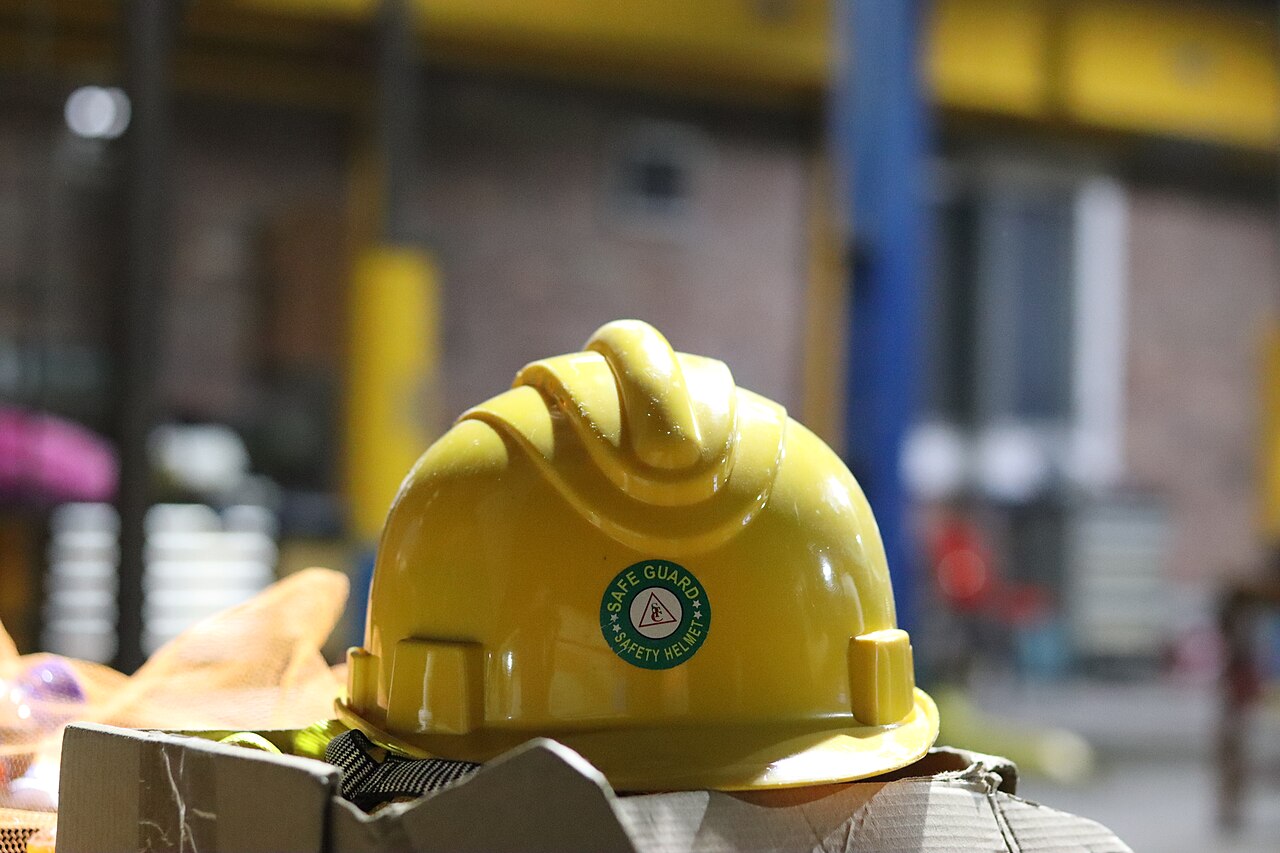
EN 397 is the European standard for industrial safety helmets. It requires shock absorption, resistance to penetration, and flame resistance, plus a test that the chin strap or anchorage releases correctly under load.
IS 2925 and other regional equivalents
IS 2925 is the Indian (BIS) standard for industrial safety helmets and is broadly aligned with EN 397. In the US, ANSI/ISEA Z89.1 is the equivalent, with Type I (top impact) and Type II (lateral impact) classifications.
Optional markings worth knowing
Beyond the base test, helmets can be marked for electrical insulation (440 V AC), very low temperature (-20 °C or -30 °C), or molten metal splash (MM). These are additional and optional — a helmet without them has not been tested for those hazards.
Fit and lifespan
The suspension harness should be adjusted so the shell sits roughly 25–50 mm clear of the skull. A helmet that has taken an impact must be replaced even if it looks intact, and most manufacturers give a working life of about 2–5 years from the manufacture date — the date stamp is moulded into the shell.
Tests conducted: IS 2925
How Mallcom tests its products to this standard.
Shock absorption
The helmet shall be mounted on a wooden head form of appropriate size. The wooden striker weighing 3 kgs and having a horizontal striking face of 180 mm X 180 mm, shall be raised to a clear height of 1.5 m above the point of contact with the helmet and allowed to fall freely. A record of the force transmitted during impact shall be made.
Penetration resistance
Mount helmet on an appropriate headform. Drop freely a plumb bob of 500 gms mass with a conical steel point having an included angle of 36 degrees and a spherical point radius of not more than 0.5 mm from a clear height of 3.0 m with the pointed end downwards on to the top of the crown of the helmet. Examine the helmet for piercing or denting, failure of any integral parts etc.
Flammability resistance
With the helmet upside down and the burner angled at 45 degrees to the vertical, the end of the flame shall be applied to the outside of the shell at any suitable point between 50 & 100 mm from the crown for a period of 10 seconds. The plane tangential to the test point shall be horizontal. The shell shall be examined for flaming 5 seconds after removal of the flame.
Electrical resistance
Invert the helmet and place it on a frame in a suitable container. With a solution of 6g/l of water, fill the container and the helmet to within 12mm of the junction of the brim and the dome, or if the helmet is provided with holes to a depth of 12 mm below the holes. Allow the helmet to remain in the solution for a period of 18 to 24 hours and maintain the temperature of 25 degrees to 35 degrees Centigrade during this period. Then apply an alternating voltage of 2000 V at 50Hz for 1 minute between electrodes placed in the solution inside and outside the helmet respectively. If no electrical breakdown occurs, disconnect the high voltage supply and connect a milliammeter in the circuit on each side of the electrode. Raise the test voltage slowly observing the ammeter reading, until the applied voltage is 2000V.
Water absorption
The sample used for shock absorption is used for carrying out this test. Weigh the sample (full shell). Immerse for 24 hours in water at a temperature of 25 to 35 degrees centigrade. Remove from water, dry the surfaces by wiping them and weigh again. Report the average gain in mass as a percentage.
Heat resistance
Place the shell in an oven maintained at a temperature of 93 degrees centigrade. The shell shall be shielded from direct radiation during the test. Remove the shell from the oven and examine for separation, distortion or softening.